

K.R. Ledbetter
November 05, 2026 | 6 minute read
“Christians are people who expect to be spoken to by God.” That line from the book “Being Christian” by Rowan Williams has been echoing through my head, heart and life since reading it earlier this year.
Yes, as a matter of fact, I do expect to hear from God! He knows and loves me and communicates with me because he wants me to know and love him. That is one of the major purposes of prayer.
That truth causes my focus to be drawn both outward and inward. Outward because God speaks through the Bible and his creation. Inward because God speaks through the Holy Spirit, who dwells in my heart and the hearts of every other follower of Jesus.
If I lived my life without believing that in the beginning was the Word, my focus would center on just myself. I would miss out on the ever-present awareness that God is always saying something and that he wants to talk to me.
Talking to God and taking time to listen to him is prayer.
What is the purpose of prayer? To talk with God and walk with God.
Or to put it another way, prayer is the conversation we have while he leads us.
Talking With God
The basic components of a conversation are speaking and listening. You say something and the other person listens to you. Then they say something while you listen to them. And back and forth it goes. Have you ever felt trapped in a one-sided conversation where someone talks constantly without giving you a chance to respond? Those conversations aren’t fun or helpful, are they?
Despite having spent most of my career as a writer, I consider myself an awkward conversationalist. When it’s my turn to talk, I feel worried that I’m not communicating my thoughts well. What if I say something that sounds rude or foolish? If only I had a pen and paper, I could write out several variations and make sure to choose the best words.
Thank goodness that there is no such stress or worry in prayer. When talking with God, I am sure he perfectly understands my imperfect words.
The part I find more challenging is listening.
Listen First
You’ve probably heard some variation of the saying that we have two ears and one mouth so we can listen twice as much as we talk. Listening first is an integral skill of having a good conversation. Just like that one-sided conversation, we don’t want to only come to God and talk on and on without stopping to listen. We don’t want to give him a list of requests and then not stop to receive guidance.
Matthew 6:5-8 warns against praying conspicuously to get others to notice us. It also says not to babble to make our prayer as wordy as possible. Both scenarios sound like monologues or performances, don’t they? That’s not what prayer should be.
Let your prayer time hold comfortable silence while you listen to God. Instead of filling every moment with sound, deliberately choose to be quiet at certain moments of the day, such as while drinking coffee, traveling home from work or taking a walk. Or make a reminder to pray at a specific time of day, to stop whatever you are doing and spend a few moments of time with just God. You and a fellow believer might build a habit of listening to God by adopting the same practice of silence and periodically asking each other about it.
Speak Afterwards
The other part of prayer is talking to God. Jesus isn’t looking for the perfect words. He’s looking for an open heart.
Still unsure what to say to the person who paid the price of sin with his death on a cross?
You could say something like, “You are worthy, our Lord and God, to receive glory and honor and power, for you created all things and by your will they were created and have their being.” Praying Scripture back to God is a great way to pray. In Acts 4 the early Church prayed Psalm 146:6. When Jesus was on the cross, he prayed Psalm 22:1. And in the Old Testament, King Hezekiah prayed Psalm 146. When we are at a loss for words, turning back to Scripture and repeating the words God has already given us is a great way to start the conversation.
You could also say something like, “Dear Jesus, I have been working so hard for so long to find a helpful treatment for my health condition, but I still haven’t succeeded. I’m exhausted by my efforts and discouraged that I have to deal with this at all. Please help me.” It’s okay to be honest and talk to God like we would talk to our most-trusted friend. He already knows what we’re feeling and experiencing, and he wants to help us through it.
The purpose of prayer is communion with God — a relationship in which we can both praise him and bring him our burdens. We acknowledge him as king and ask for guidance, share our griefs and glorify him while understanding his will and telling him our hopes and fears.
There’s nothing too big or too small to discuss with Jesus. Since he’s strong enough to bear the weight of the world’s sin, he is more than able to comfort us, teach us, guide us and encourage us.
Walking With God
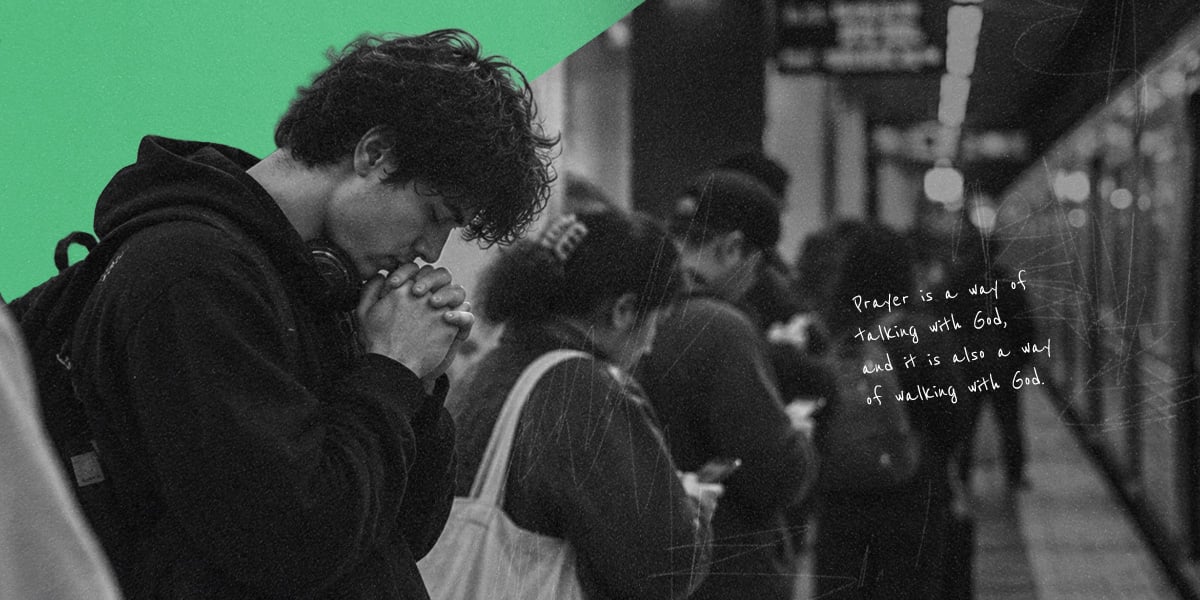
Prayer is a way of talking with God, and it is also a way of walking with God.
When you walk with someone, you spend time together moving in the same direction.
I like to imagine what it must have been like in the Garden of Eden before the fall when God took an evening walk with his people. Perhaps they asked him for knowledge about how to better care for the world. Perhaps he enjoyed hearing stories about their discoveries during their work. Maybe they were sometimes silent and watched the sunset together.
Prayer is more than a mere conversation — it’s a conversation with direction. When we walk with God, we let him choose the pace and direction. We might ask him where we’re going and when will we get there (as I’ve asked many times), but I’ve found it’s better to be present for the journey instead of skipping ahead.
Prayer is spending time with Jesus, following him, asking and allowing him to be first in our life. The purpose of prayer is not to just finish talking quickly and finally get to the rest of our day. The purpose of prayer is to follow Jesus, no matter where he leads.
There’s a short dialogue between Jesus and Simon Peter that helps illustrate this point. Jesus just finished teaching about salvation using the metaphor of eating bread, declaring that he was the bread of life. Many people, not understanding, complained and deserted him. So Jesus asked his twelve closest followers whether they would leave too.
Peter says, “Lord, to whom shall we go?” Notice that Peter doesn’t say, “Lord, where shall we go?”
We aren’t following Jesus to get to a certain place. Jesus himself is the destination. We follow him because he’s Jesus. We pray because he’s Jesus.
As Peter pointed out, only Jesus has the words of eternal life. He speaks to us and we listen. He walks in the garden and we join him. When we practice the discipline of prayer, we are setting our life in line with his Word and following one step at a time.
Unity With God
Once, humans walked with God face to face, but then we lost the right to walk with God. Therefore, Jesus became human to walk with us. Someday soon, we will walk with him again. In a sense, this is the ultimate destination of the journey: Unity.
As Ephesians 1:9-10 explains it, “He made known to us the mystery of his will according to his good pleasure, which he purposed in Christ, to be put into effect when the times reach their fulfillment — to bring unity to all things in heaven and on earth under Christ.” Prayer helps us understand and follow God’s will and brings us into greater unity with Jesus.
Does this promise about a unified future sound as lovely to you as it does to me? I can hardly wait to spend eternity in a heaven and earth unified under Jesus. We will get to experience the restoration of humanity’s relationship with God. Things will be how they used to be in Eden, but even better.
However, it can be hard to remember all of this when I’m bowing my head in church, anticipating the end of the worship service. I’m also not really thinking about unity when I’m telling God about my sadness, frustration or fears about the near future. I usually fail to take an eternal perspective when I’m praying a memory verse or other familiar style of prayer, like grace before a meal. These are probably moments when I need to remember the purpose of prayer more than ever.
Why do we pray?
To listen to him.
And to talk to him.
While following him.
In the hope of unity with him.
Christians are people who expect to be spoken to by God. We are also people who speak to God and are heard by him.
What an honor to be able to pray for others to receive salvation, to grow in discipleship, to experience healing or protection or encouragement and to bless others . What an honor to listen to God together with other believers and to follow him together with our neighbors across the street and around the world.
At this present time, prayer — walking and talking with Jesus in the Spirit — is so very close to the unity that we look forward to in Jesus. I don’t know exactly what that will be like, but I’m certain it will be amazing.


K.R. Ledbetter lives in North Texas with her teacher husband, teenage daughter, and rescue dog. A lifelong lover of literature, she can usually be found with a book in hand but also enjoys traveling, quilting, and playing board games. One of her favorite Bible verses is Psalm 145:8-9.
 Back to All Posts