

K.R. Ledbetter
November 19, 2026 | 5 minute read
At two months short of turning 21, I was one of the youngest people at my own wedding. I got married on July 20, 2008, three and a half years after first meeting my husband. We’d been dating for three years and engaged for four months. Since then, we’ve experienced better and worse, richer and poorer and sickness and health many times each. Now after nearly 20 years of marriage and more than 20 years of friendship, my husband and I are pretty good at understanding and communicating with each other.
Think of one of your closest relationships — parent, sibling, spouse, child, friend. You have a way of speaking that doesn’t always need words. Their one slightly raised eyebrow, for instance, can cause you to burst into laughter. Your long history of love and trust has shaped the language you use with each other. It’s why you can sigh, relax and be yourself when you’re together. It’s why they can understand what your sigh means without having to ask.
Prayer can be just like that as well — a unique language that grows with each year of your relationship with Jesus.
I used to ask, “How often am I supposed to pray?”
But that’s like asking, “How often am I supposed to talk to my spouse?” That would be missing the point of marriage.
Just as it’s missing the point of being a follower of Jesus to pray first thing in the morning and never again for the rest of the day. Or week.
In the 6,650ish days since I married him, my husband and I have talked at least once every day (or nearly every day) but usually many times on and off from morning to night. We aren’t trying to meet a daily target of minimum words exchanged. We communicate spontaneously and pretty much constantly. We love each other and enjoy sharing our thoughts.
Which is why there’s no concrete answer for how often to pray. Like many of the best parts of life, it depends.
What does it mean when the Bible instructs us to pray continually? To me, it means maintaining an ongoing conversation with someone who knows us extremely well. It’s the type of closeness where we are always in communication, like that of a sibling or best friend.
In the verses above, the idea of “always” is repeated three times: always be joyful, always be prayerful, always be grateful. Each of these attitudes and actions is a choice that we can purposefully make at any moment. Between the option to pray or not pray, we can always choose to listen and talk to God.
It’s not only possible to pray continually, but it’s also a great joy.
A much younger version of me used to scoff at this verse. “What, am I supposed to pray all the time?” I wondered. Did praying really mean continually bowing my head and closing my eyes every single minute? I was thinking this impossible practice would leave very little leisure for reading fantasy novels featuring dragons, which was my primary interest in middle school. (I still enjoy this pastime.)
Little did I know that my relationship with God would deepen as I matured. He has patiently nurtured me from someone who thought prayer was something my parents made me recite before bedtime into a follower of Jesus who speaks with and hears from the Holy Spirit throughout the day.
“Give us each day our daily bread.”
We usually eat every day, so we can pray every day for and over our food. This seems like a straightforward instruction about prayer. Pray about Wednesday’s needs on Wednesday and Thursday’s needs on Thursday and so on.
That means that to pray for daily bread, we need to pray every day. Logistically, we can’t pray for tomorrow’s bread because tomorrow isn’t today, and there’s no point in praying for yesterday’s bread (other than expressing gratitude) because God has already given it to us.
Now, our daily prayer for God’s provision shouldn’t sound like a shopping list. God already knows that we need food and water and clothing and shelter. This is probably one reason why Jesus tells us to seek the heavenly kingdom first before we seek to accumulate earthly things, such as closets full of clothes or bigger stockpiles of food.
The forward-thinking, future-obsessed planner in me needs this reminder. I tend to borrow extra trouble from tomorrow and worry about it today, even though, intellectually, I know it’s fruitless. I’m exactly like the Israelites who wanted to save up extra manna just in case because it made tomorrow feel a bit more secure. Spoiler alert: This does not work.
Daily prayer is about renewing our faith. It’s appropriate to acknowledge how much we depend on God and to trust that he will meet our needs. If we are experiencing a physical need, we might pray for actual bread. If we are experiencing a spiritual need, we might pray for the faith to quiet our worries, the courage to invite someone to church or the obedience to follow where God leads us next.
While deciding whether to adopt a child, one of the biggest and most difficult decisions of my life, I experienced anxiety and insomnia. I would regularly be awake in the middle of the night for hours, imagining the worst possible circumstances and outcomes. Talk about borrowing trouble from the future!
But during those sleepless, fretful nights, I also prayed.
Jesus told me what he has told many others: Do not be afraid, for I am with you. He was right, of course. Our adoption, though not without its obstacles, could never have happened without him.
We can turn to God in prayer during a crisis. It can be a comfort to know that we are not alone when we bring our pain and fears to God. People of great faith and little faith have all recognized their need for God in some of their hardest moments:
Not only is there nothing wrong with crying out to God when we are deeply troubled, but God is better equipped to love and comfort us in these moments than anyone else. He hears us. He sees us. He knows our suffering. He loves us.
Because Jesus is both God and human, he empathizes with our struggles. He was hungry and thirsty too; he was sad and afraid too; he was tempted to sin too. In the same way we face physical, emotional and spiritual challenges, so did he. It is a great consolation that Jesus is with us and understands our needs.
“Be joyful in hope, patient in affliction, faithful in prayer.”
To do something faithfully means to do it persistently without giving up. It means to make a habit or regular practice of something. We can play the guitar faithfully, bake bread faithfully, pay bills faithfully and tend the garden faithfully. The actions may take place daily, weekly, monthly or seasonally, but to do them faithfully, we do them on time without fail.
I was recently talking to my dad about rituals. He and my mom have a sweet morning ritual: he wakes up early and turns on the coffeepot that she set up the night before. They drink their coffee, read the verse of the day on their Bible app and play Wordle together. If they had houseguests, they would still do this. If they were traveling, they would still do a version of this. They are faithful in coffee, Bible reading and word puzzles.
To be faithful in prayer, then, is to pray according to a chosen rhythm, a predetermined cadence.
Take the prophet Daniel. He faithfully prayed three times a day facing Jerusalem, regardless of whether his political enemies were trying to have him legally executed with lions. As long as he was conscious, he would keep his appointment to pray with God.
God didn’t force Daniel do this or penalize him if he forgot. Daniel seems to have felt that praying at morning, noon and night was a good habit for maintaining his relationship with God. If he prayed two times a day or ten, that would be a good rhythm too. It was the fact that he maintained his practice that made Daniel faithful in prayer, not whether he made it to his knees at exactly the same time each day.
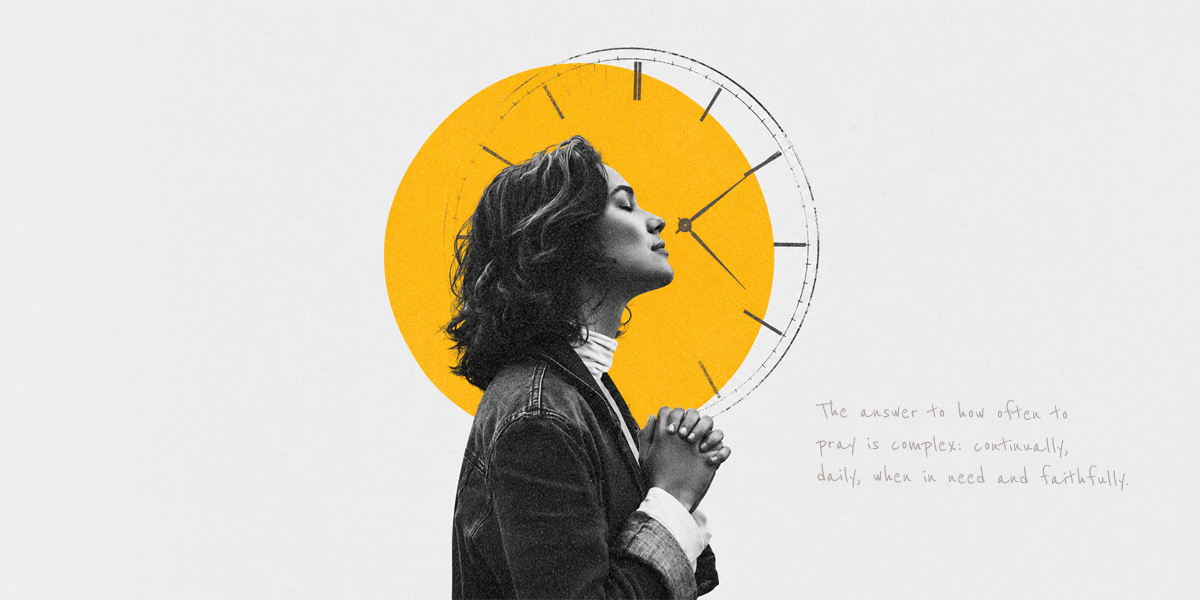
The answer to how often to pray is complex: continually, daily, when in need and faithfully.
But here’s the bottom line.
If you think you should pray a bit more often or a bit longer, you probably should. If you’re not sure whether now is a good time to pray, it probably is. And if you need God in your hardest moments, do not be afraid. He is with us always.


K.R. Ledbetter lives in North Texas with her teacher husband, teenage daughter, and rescue dog. A lifelong lover of literature, she can usually be found with a book in hand but also enjoys traveling, quilting, and playing board games. One of her favorite Bible verses is Psalm 145:8-9.
 Back to All Posts